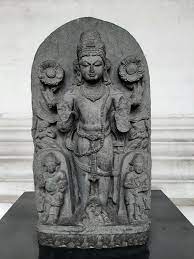
ORIGIN: Hindu (Vedic, Epic and Puranic)
TYPE: Sun God
KNOWN PERIOD OF WORSHIP: circa 1700 BCE until present.
SYNONYMS: Diakara (day maker); Grahapati (king of planets); Surya Narayana
CENTER(S)OF CULT: The "Black Pagoda" shrine at Konorak in Orissa; also throughout India.
ART REFERENCES: Sculptures from 600 CE, including erotic reliefs at the "Black Pagoda", usually in bronze, less frequently in stone.
LITERARY SOURCES: Rg Veda and other Vedic texts, Epic and Puranic Texts
INFORMATION: In the Vedas Surya is a prominent figure, not only the personification of the sun in the heavens and of cosmic order, but also a source of infinite knowledge. Considered to have been introduced from Iran, he is head of the Aditya group of sun deities. He is the son of Dyaus and Aditi and his consorts include Laksmi, Chaya and Sanjna. HIs children include Manu, Revanta, Yama, and Yamuna, and a sun goddess also called Surya.
Surya is depicted either standing or seated, sometimes driving a one-wheeled chariot drawn across the sky by up to seven horses. He bears four arms. In northern India he is usually found wearing knee-length boots. In the south he goes barefoot.
ATTRIBUTES: band, club, conch, knife, two lotuses, prayer wheel, staff with lion, trident and war drum. May be three-eyed.